

By Roel Hoang Manipon
Every year, residents of Tabawan Island gather for one of their important celebrations, the Pagkamboan. Those living or working in other places but who trace their roots to the island return home to be with families and friends for a tradition of honoring and remembering the dead and the spirits of ancestors, practiced even before the arrival of Islam in Tawi-Tawi.
Tawi-Tawi, a cluster of islands between the Sulu and Celebes Seas, is the southernmost province of the Philippines, predominantly populated by the Sama, the seafaring people of Maritime Southeast whose traditional home range also includes parts of Malaysia and Indonesia. The Philippine Sama is generally grouped into the land-dwelling Sama Diliya and the mostly sea-dwelling Sama Dilaut, who are known for their houses built over the water and standing on stilts.

I have been coming to Tawi-Tawi for several times, fascinated with the Sama ways of life and traditional cultures. This time, we were going to Tabawan Island upon the invitation of Omarjan Ibrahim Jahuran, writer, cultural worker and Indigenous Peoples Mandatory Representative of the municipality of South Ubian.
After about two hours on a speedboat from Bongao, the capital of Tawi-Tawi, that sliced through the Celebes Sea, we arrived in Tabawan Island, the main island of South Ubian, in the northeast part of the province, a day before the Pagkamboan, which fell on March 5 in 2024. Pagkamboan is celebrated three to five days before the start of Ramadan, a time for fasting in Islam, in the Islamic lunar month of Nisfu.
The Sama Tabawan live in about four residential clusters, in houses built on stilts over the water, on the shores of the island, leaving most of the land area uninhabited. The Sama are afraid of ghosts which haunt the land but cannot cross the water, joked Jahuran, who has been advocating for the safeguarding of the heritage and traditions of his home island including the Pagkamboan.
While the Pagkamboan is still practiced in some communities in Tawi-Tawi, Tabawan’s celebration is most likely the biggest and most vibrant, and the Pagkamboan is one of the most compelling manifestation of the ancient practice of ancestor veneration that survives until today among the Sama people.
Many believe that Islam was brought to Tawi-Tawi by Sheikh Karim’ul Makhdum, said to be an Arab missionary from Syria, who arrived in 1380 in Simunul Island (Some say in Sibutu Island).
However, ancestor veneration still survives in some form or way, mostly syncretized with the prevalent religion, especially among the Sama Tabawan. It is in our way of life, said Jahuran. And this can be observed in everyday life, not just during Pagkamboan.
While at the house of the grandmother of Almunshar Alpha Astarani, one of our guides, we noticed an empty room, reserved for the spirits of the family’s ancestors, should they decide to stay or rest for a while. While it is not forbidden to stay or sleep in the room, no one uses the room. The big houses for the ancestors, the luma pagkamboan, have similar purposes.
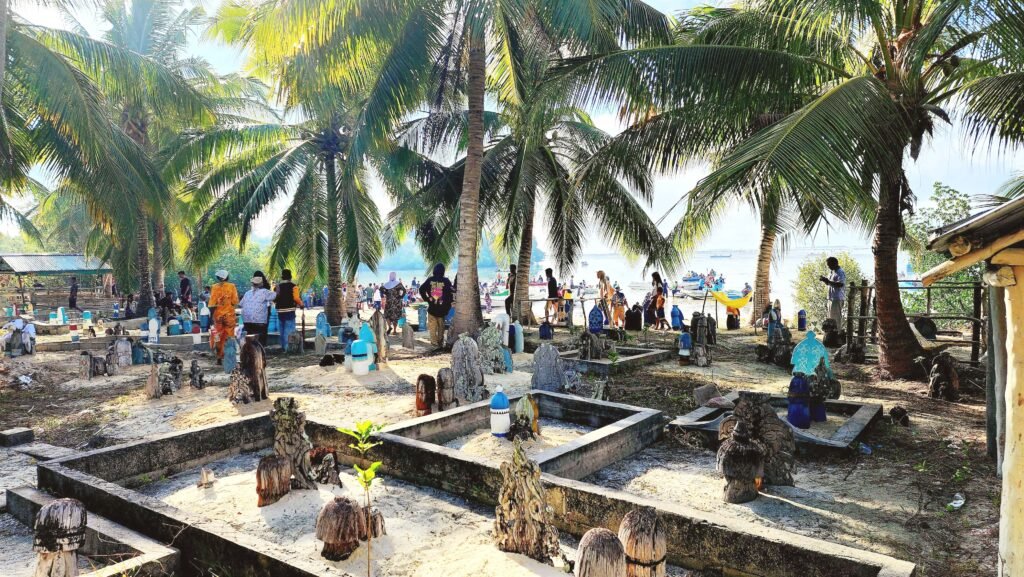
An important part of Pagkamboan is visiting the grave site, which is located on Bumbun at the northwest tip of Tabawan. Yearly, Tabawan residents make a pilgrimage to the gravesite to take care of the graves of their dead and perform rituals. Even the day before Pagkamboan, some residents visited the site to avoid the crowd.
While most of Bumbun is dedicated to the Muslim dead, there is an area for the Catholic dead. The town has a very small population of Catholics and even Chinese-Filipino. Some residents tell stories about a creature that prowls Bumbun Island. The kangkang laut, which looks like a large monitor lizard or even a dinosaur, is said to emerge at midnight to dig up fresh graves and devour the newly buried dead.
The day before the Pagkamboan, residents were already preparing, particularly cooking the two foods that are always present during the special occasions—the panyam and the jah—both made of rice flour.
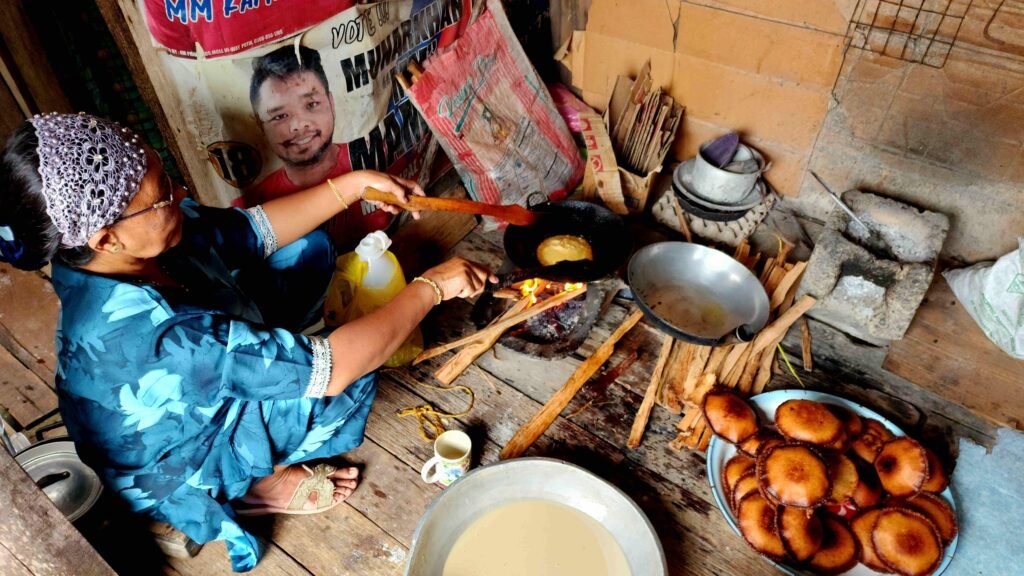
PHOTO BY ROEL HOANG MANIPON
We met 61-year-old Jannatun Jahuran, who has finished making trays of panyam.
“This is the panyam to be included in the dulang (food tray) for the prayer to our ancestors tomorrow that we call kamboan, during the month of Sha’aban. Panyam and jah should always be present for the prayer ritual during kambo’an especially here in our community, in the barangay of Tangngah. We should offer these rice cakes for our dead ancestors,” she explained in her native Tabawan dialect of the Central Sama or Sinama language.
In a nearby house, we observed another woman cook the cake. Rice flour, brown sugar and coconut milk were mixed to form the batter, which was then fried in oil. Using a wooden stick, she made dents on the edges of the cake to make it look like a flower.
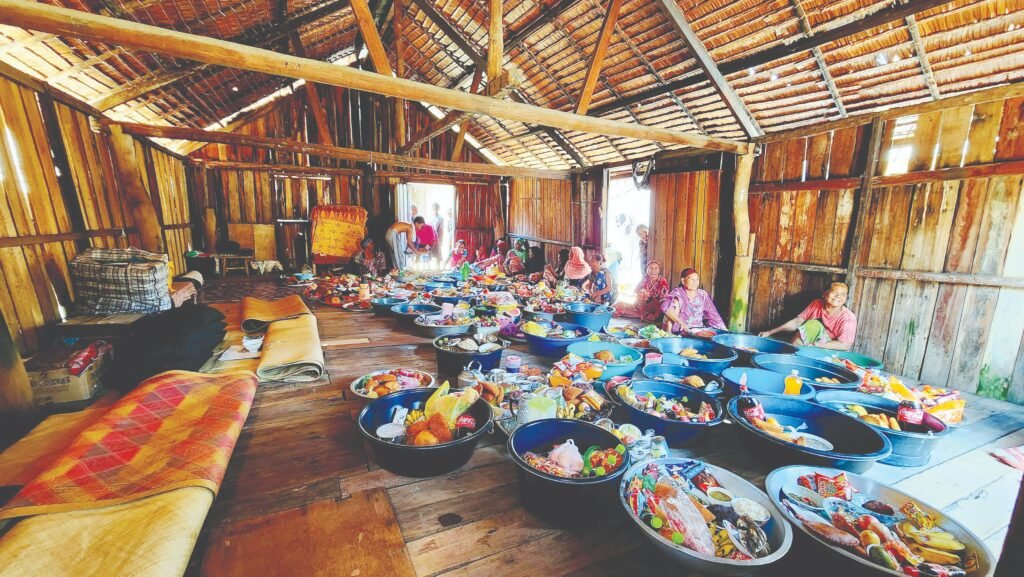
PHOTO BY ROEL HOANG MANIPON
At another house, we met 28-year-old Marhaini Asande, making the jah. She said she learned how to cook jah from her neighbor.
With the panyam and the jah already prepared and the sun slowly setting in a blinding blaze over the water with rays piercing through cracks and slits of the langgal and the luma maheya, residents readied themselves for more cooking and the trip to the graveyard the following day.
The day of the Pagkamboan started early. Before the sun rose as the community was still sleeping, elders and religious leaders gathered for a meeting inside the luma maheya and decided to go to Bumbun ahead of the crowd to perform the little rituals on each grave, knowing they would be pulled here and there by people to say a prayer on the graves of relatives and family members. As the rays of the sun crept through the rows of roofs, the elders boarded a boat and headed to Bumbun.
By seven in the morning, families, groups of friends and their guests in small boats started to make their way to the graveyard island. Later, more boats appeared until a line of boats has formed like a procession on water. The shore of Bumbun would be covered with boats. Those who arrived late would have to hop from boat to boat to reach the shore.
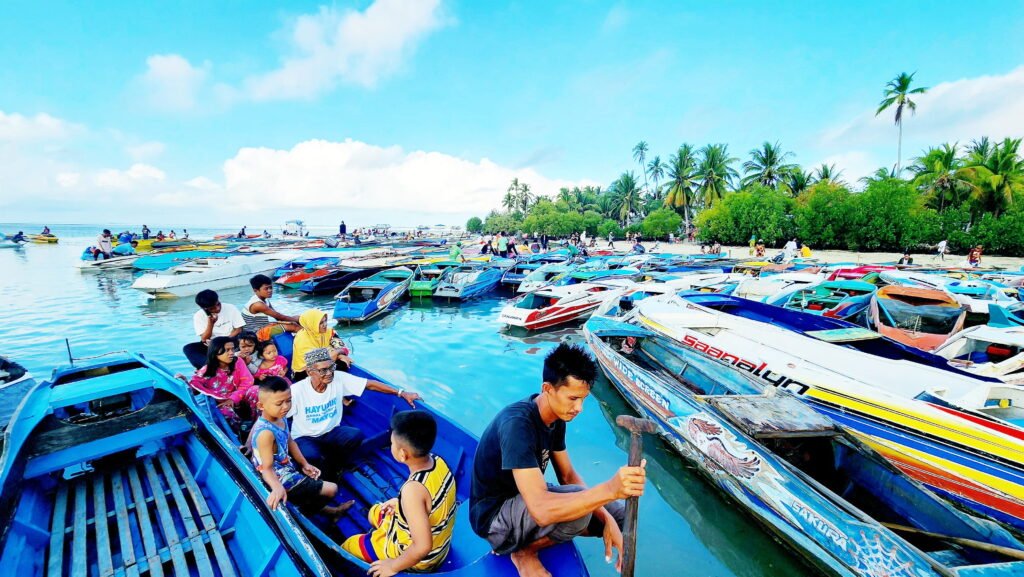
PHOTO BY ROEL HOANG MANIPON
The graves were marked by the sunduk, the grave marker of the Sama, made of wood or stone. There are two kinds of sunduk—the phallic ones, indicating the dead was male and the flat ones, indicating the dead was female. The traditional ones are characterized by decorative carvings called ukkil or okir.
The graveyard was now busy with people. For Catholic Filipinos, the scene is reminiscent of the undas on November 1.
Tabawan residents gathered sand and replenished the graves that have eroded through the year. Elders or imams performed the ceremonial pouring of water using a coconut shell over the sunduk and recited prayers or supplications. Some would leave items, such as cigarettes, favorites of the dead when they were still living, as offerings.
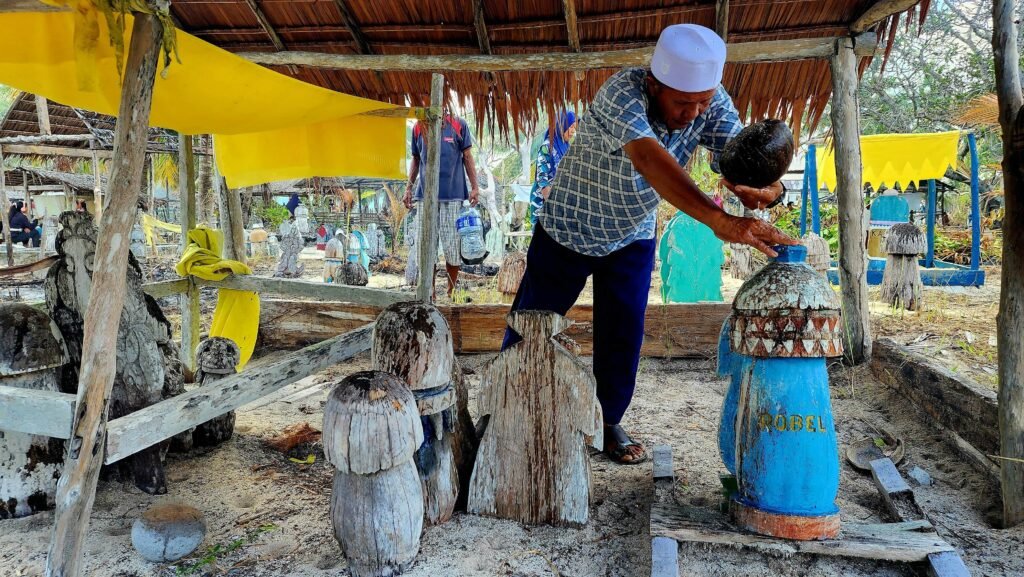
PHOTO BY ROEL HOANG MANIPON
By late morning, residents returned to their homes and continued preparing food for offering and feasting. The food items, dishes and drinks went to the preparation of the dulang, which refers to the traditional circular food trays, as well as the arrangement of food on the dulang, or modern receptacles in place of the dulang. Plastic or aluminum tubs or basins are now commonly used.
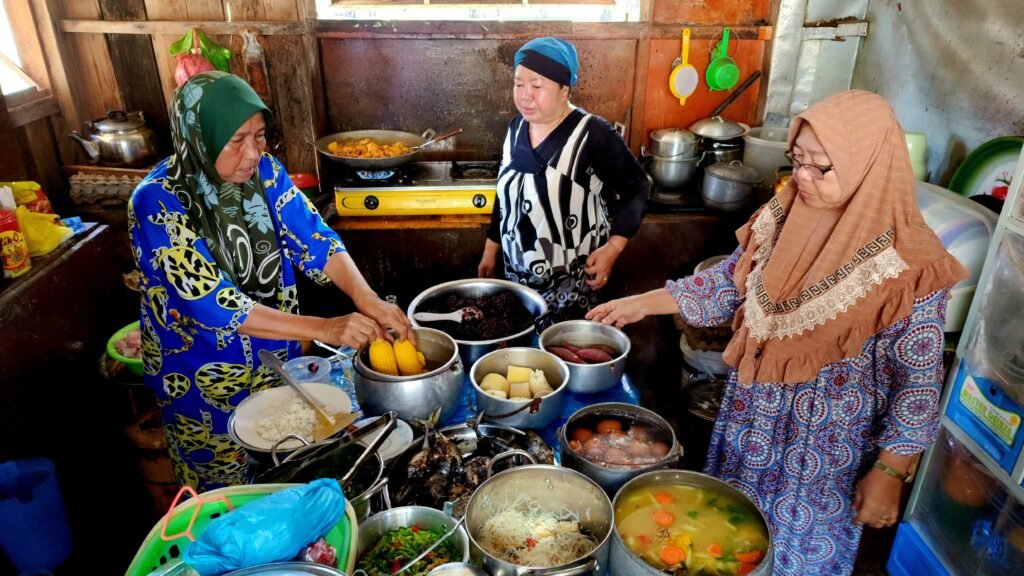
We dropped by the busy kitchen of Tang-ngah barangay captain Nuthamima Abdurajak Sarajan, who was cooking up a feast with the help of her sisters Sitti Jumliha Abdurajak and Nurbaria Abdurajak, constantly moving around kitchen and dissipating the steam that came out from the pots. They showed us the different stews and their wadjit, a sweet treat made of black glutinous rice.
By noon, residents began bringing their dulangs to the luma pagkamboan in their area. We passed by the luma pagkamboan in the barangay of Laud, which was beginning to be filled with dulangs. But the Tang-ngah luma pagkamboan has been the most popular one for residents. Soon, the house overflowed with dulangs, spilling into the letehan. More people still arrived bearing their dulangs. Those who resided far from the luma pagkamboan arrived by boats.
Surrounded by a sea of dulangs inside the luma pagkamboan, the elders and imams started the pagduwa-a, praying for thanksgiving and supplications to the ancestor spirits, both in the Central Sama, the language of their ancestors, and in Arabic, the language of their religion, and inviting them to partake of the feast or food offerings.
“Pagkamboan recognizes the interconnection, interdependence and harmonious relationship between the world of the living and the ancestral spirits and dead members of the community, who they invoke and talk to from time to time in the graveyard or in the ancestors’ house as if they are beings in a different dimension or parallel universe,” Jahuran explained.
He said, “This shared communal value provides social cohesion among the inhabitants of the island community.”
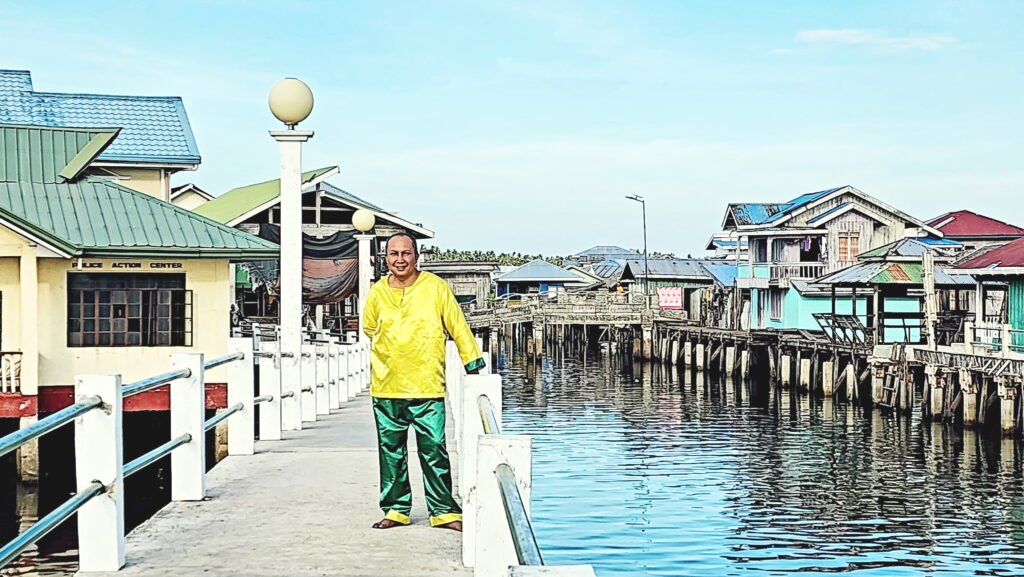
Though still practiced, the Pagkamboan is in danger of vanishing together with other traditions, many distinct to the island. The old, traditional structures are also experiencing disrepair. A heritage advocate, Jahuran authored an ordinance identifying Tabawan’s intangible and tangible pusaka kamboan or cultural heritage and mandating their safeguarding. It was unanimously passed on November 16, 2020. The list included structures and sites such as the langgal, the luma maheya, the Bohe Deya or forest well, the entosan (traditional log pressing mechanism), laitan (an island for sail stitching), Kuta Tabawan or Tabawan Fort, which some believe to have been built before the arrival of Islam, and Bumbun. Identified intangible cultural heritage elements are paghinang sunduk or the making of traditional wooden grave markers; pag-anom tepo Tabawan or the weaving of Tabawan mats; pagjamu, the communal spirit appeasement ritual; pagduwata, a healing ritual; igal Tabawan, or traditional dance with steps unique to Tabawan; tagunggu’an Tabawan or titik Tabawan, traditional ensemble music; panyam maka ja or the making of traditional ritual rice cakes; and the Pagkamboan.
After the pagduwa-a, residents retrieved their dulangs and brought them to their homes. The feasting began, where everyone is invited. We had the honor to partake of a meal with the village elders. Our hosts invited us to a second one in their home. There would be more invitations to eat as we wound our way through the community. A large family and their friends and neighbors partook of a feast laid out on the walkway beside their house, and anyone who passed by is invited to join in.
Here in Tabawan Island during Pagkamboan, food is also an important part bringing together people, even of different cultures, strangers and friends, and it also connects the living and the departed, those who are away to home, the body and the spirit, and the past and the present and hopefully the future.